

How To Arrange Two Desks In An Office



Two-person home office setup. One room, two rhythms, zero chaos.
Key facts
- Back-to-back and one-wall layouts are the two most space-efficient setups for two-person home offices.
- Matching desk and chair bases reduce visual clutter and make small rooms feel larger.
- Storage placed between or beside workstations keeps shared spaces organised without eating into desk space.
Sharing a home office with a partner or housemate works best when the layout is chosen to suit the room, not forced to fit it. This guide covers five practical layouts - back-to-back, one-wall, zoned, compact, and dining-room conversions - plus how to balance function and style so the space works for two very different people. It's built for anyone setting up a shared home office without a spare room to spare.
What should you consider before setting up a shared home office?
A home office for two is a negotiation first and a design project second. Get the basics sorted before you touch a floor plan.
- Function first - the room has to work for two different jobs, two different schedules, and two different levels of mess tolerance.
- Style second - you don't need matching desks, but a consistent palette stops the room looking like a flea market.
- Noise and calls - work out early who takes calls where, so you're not both talking over each other by 9.15am.
- Storage split - decide what's shared and what's personal before the boxes arrive, not after.
How do you maximise a small shared office space?
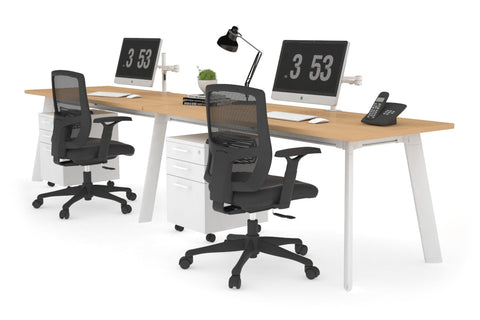
A limited footprint doesn't rule out a proper two-person setup - it just means the layout has to do more work.
- Position both workstations perpendicular to the walls. It's the most efficient way to fit two desks without the room feeling congested.
- Choose workstations and chairs with light, open bases, which cut visual clutter and make the room feel bigger than it is.
- Match the desks and chairs where possible. A streamlined, repeated look reads as considerably more spacious than a mismatched one.
Why does a back-to-back layout work so well for two people?
Sitting back-to-back keeps you out of each other's eyeline, which means fewer distractions and fewer accidental glances at someone else's inbox. It also gives each of you a clearly defined zone that's unmistakably yours.
- Swivel chairs let you spin around and chat on a break without shifting the whole desk setup.
- A wall of bookcases behind the desks adds serious storage without stealing floor space.
- This layout doubles as useful prep for a return to a traditional office, since the storage stays handy either way.
How does a one-wall workspace suit shared offices?
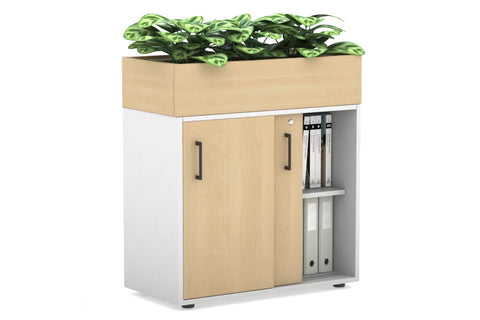
If symmetry appeals to you, a one-wall setup lines both desks along a single wall and leaves the rest of the room free. It's an ideal choice when the office shares a larger common area, since the whole two-person setup only claims one side of the room.
- Add a storage cabinet between the two desks to create breathing room and a practical divide.
- Choose bigger home office desks for this layout - the extra surface area earns its keep when storage sits in the middle rather than underneath.
When should you create two separate zones instead?
Got the room to spare? Split it properly. Two separate zones give each person their own patch, rather than a shared desk run down one wall.
- Position the workstations on opposite sides or ends of the room for maximum separation.
- Give each zone its own storage for supplies and personal items, so neither of you is reaching across the other's desk.
- This layout suits two people with genuinely different working styles - one who likes a clear desk, one who doesn't.
Can a dining room double as a two-person home office?
No spare room? No problem. A dining room table can do double duty as a shared office, provided you set a few ground rules.
- Sit at opposite ends of a long, rectangular table for a sense of separation without losing the ability to talk through the day.
- Connect a monitor or wheel in a filing cabinet for proper document access, even at a dining table.
- Pack it all away on weekends to turn the room back into a dining room and put proper distance between you and work.
Why JasonL is trusted. Built for reliability. Delivered without delays.
JasonL supplies home and small-business offices across Australia with furniture built to arrive on time and last.
- 3-5 working day delivery on stocked items, so your shared office isn't held up for weeks.
- Australia-wide coverage, from capital cities to regional addresses.
- A large in-stock range of desks, workstations, chairs, and storage, so matching pieces are easy to find.
- Professional installation available if you'd rather not spend your weekend with an Allen key.
- 10-year structural warranty on applicable products, backing the furniture you and your co-worker will live with daily.
How JasonL compares to other suppliers. Clear differences. No noise.
Buyer decision snapshot
- Confirm stock availability before committing to a layout that needs two matching desks.
- Check whether installation is included, especially for larger workstation runs.
- Look for a warranty that covers daily home-office use, not just light occasional use.
- Favour suppliers who can deliver both desks and storage together, to avoid mismatched finishes.
| Criteria | JasonL | Large national office supplier |
|---|---|---|
| Product range | Large in-stock range of desks, workstations, chairs and storage | Broad catalogue, often with longer lead times on specific items |
| Delivery timeframe | 3-5 working days on stocked items | Varies, often 1-3 weeks depending on stock |
| Installation support | Professional installation available | Sometimes offered, often at extra cost |
| Warranty | 10-year structural warranty on applicable products | Typically 1-5 years depending on range |
| Best suited to | Home offices and SMEs needing fast, matched furniture | Larger corporate accounts with longer procurement cycles |
Frequently asked questions
What's the best layout for a two-person home office in a small room?
A compact, perpendicular layout works best in small rooms. Positioning both workstations against adjoining walls rather than facing each other maximises floor space and keeps the room feeling open rather than cramped.
Should two people share one desk or have separate desks?
Separate desks are almost always better for shared offices, even in a small space. They give each person a defined zone, reduce friction over desk space, and make it easier to personalise each side without disrupting the other.
How do you stop noise and distractions in a shared home office?
A back-to-back layout is one of the simplest fixes, since it removes direct eye contact and reduces the temptation to chat mid-task. Agreeing on call times and using swivel chairs for quick check-ins also helps keep focus intact.
Do matching desks and chairs matter in a shared office?
Not strictly, but a consistent style does. You don't need identical desks, but keeping a shared palette or similar bases stops the room looking mismatched and chaotic.
Can a dining table work as a permanent two-person office?
Yes, provided it's long enough for two separate work zones. A rectangular table with a filing cabinet nearby can function as a proper office during the week and pack away for weekend use.
How much storage does a two-person home office need?
At minimum, each person needs a dedicated space for personal items and documents. Shared pieces like bookcases or a central storage cabinet work well for items you both use, such as stationery or shared files.
What's the most space-efficient layout for two desks?
A one-wall workspace is typically the most space-efficient, since both desks sit along a single wall and the rest of the room stays free. It suits offices that share space with a larger common area.